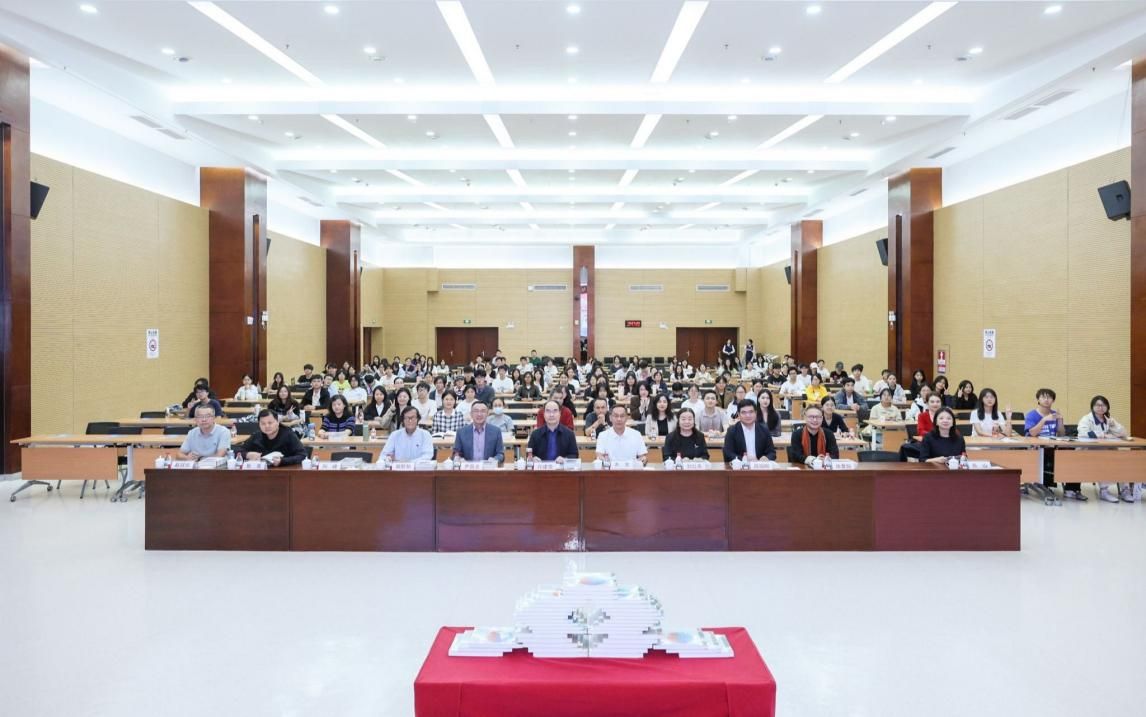
The symposium was held in Conference Room 1, Tongde Building.
On the afternoon of November 5, the “Decoding Place Names · Shenzhen’s Cultural Heritage” Seminar and Symposium on the Interpretation of theCultural Continuity · ShenzhenBook Series and Urban Cultural Spirit was held at Shenzhen Polytechnic University (SZPU). The event was jointly organized by the Shenzhen Literary Research Center, a Guangdong Provincial Social Sciences Research Base, and the School of Vocational and Technical Education at SZPU. Scholars and guests from the fields of literature, media, and urban cultural studies gathered with nearly 200 faculty members and students to explore cultural identity and urban spirit embedded in Shenzhen’s place names.
At the opening of the event, Xu Jianling, Deputy Secretary of the CPC Committee and President of SZPU, noted that culture is the soul of a city. While Shenzhen is widely known as a “window of reform and opening up,” it also boasts a history of more than 600 years as an ancient city. How to sustain historical continuity and tell Shenzhen’s story amid rapid urban development, he emphasized, requires sustained academic inquiry and talent cultivation. SZPU places great importance on cultural education and the integration of humanities with vocational and technical education. The establishment of the Shenzhen Literary Research Center, he explained, represents the university’s concrete engagement in urban cultural development. The publication of theCultural Continuity · Shenzhenseries marks an important step in promoting innovation and inheritance of urban culture. He expressed hope that the symposium would inspire cultural confidence among faculty and students and contribute to the ongoing vitality of Shenzhen’s cultural heritage.
Tracing Origins Through Names: Where Shenzhen Comes From
TheCultural Continuity · Shenzhenbook series includesShenzhen Hidden in Place Names,Understanding Shenzhen Through Place Names, andA Place to Settle. For the first time, the three authors appeared together to interpret their works, revealing layers of urban memory and cultural depth.
Mu Mu approached the topic through “the encounter between one person and two cities,” reflecting on his transformation from an observer to an active participant. He argued that Shenzhen’s place names are not merely geographic labels, but codes of migrant spirit and urban identity. Marking the 450th anniversary of the founding of Xin’an County, he visited the “Ten Peaks of Shenzhen” and all 74 subdistricts across the city. Through thematic chapters such asRivers and Seas,One River, Two Shores, andStories of Streets and Alleys, he portrayed the city’s spatial structure, emotional resonance, and historical layers.
Yin Changlong’sUnderstanding Shenzhen Through Place Namesdraws on historical documentation and extensive field research to examine the social structures and historical transformations behind place names. Using examples such as Nanling Village, Xiangmi Lake, and Dafen Village, he noted that place names serve not only as spatial references but also as carriers of cultural memory and migration history. While acknowledging that renaming is not inherently taboo, he stressed that preserving cultural continuity and aesthetic value—rather than erasing shared memory—should be the guiding principle.
Hu Yeqiu’sA Place to Settlecenters on the theme of urban belonging. He emphasized that Shenzhen’s history is deeply embedded in its place names. Names such as Fanshen and Bagualing may not represent the city’s most glamorous image, yet they document migration, labor, and growth, forming the city’s most authentic foundation. A “place to settle,” he explained, signifies not only arrival, but belonging—and serves as a spiritual anchor for millions of residents.
During the event, the three authors presented signed copies of their books to faculty and student representatives, encouraging more readers to transform “reading place names” into “reading the city.”
Discussing Cultural Continuity: Urban Warmth in Literary Dialogue
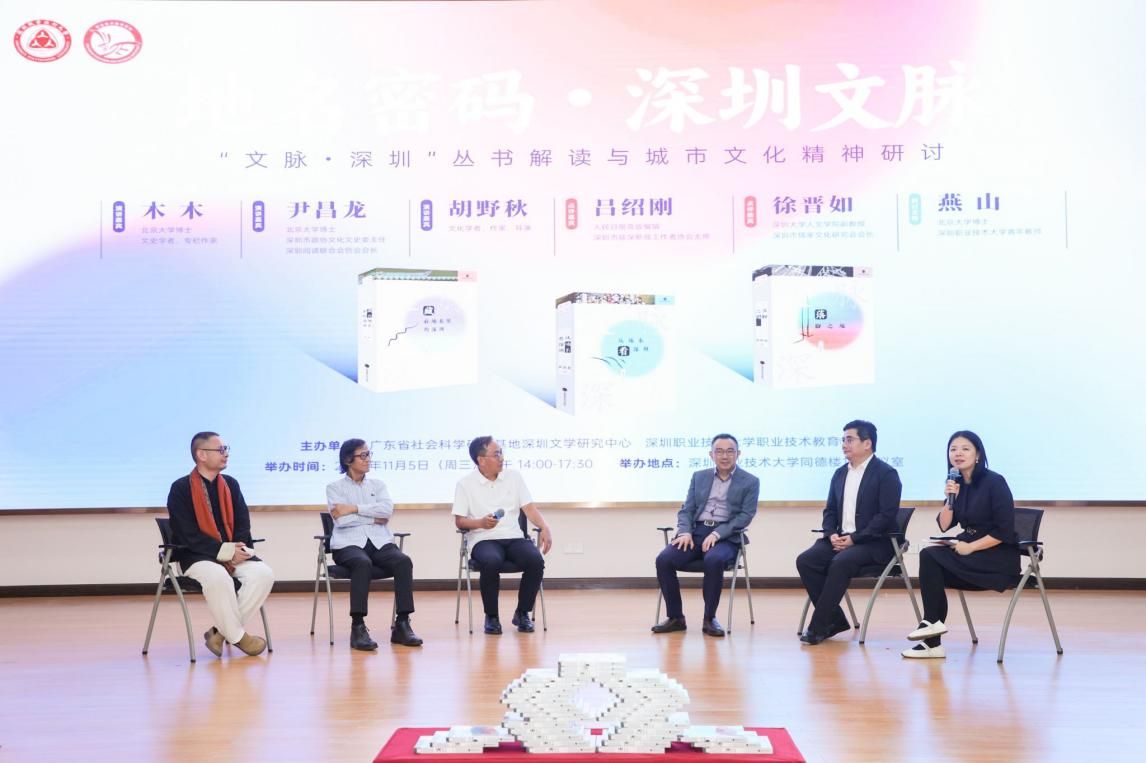
Panel discussion with invited guests.
In the commentary session, Lü Shaogang, Senior Editor of People’s Daily, observed from a literary perspective that the book series represents a form of “localized Shenzhen writing,” highlighting strong regional character and cultural identity. Xu Jinru, Associate Professor at Shenzhen University, remarked that the authors conducted genuine scholarship grounded in real investigation. Their work, he noted, situates Shenzhen within the broader Chinese cultural community, revealing deep connections between urban spirit and national narrative.
During the dialogue moderated by SZPU faculty member Yan Shan, the authors discussed challenges encountered during their writing. Mu Mu humorously noted that his emotional closeness to Shenzhen made writing flow naturally. Yin Changlong pointed out the city’s linguistic diversity as a challenge to interpretation, while Hu Yeqiu highlighted the difficulty of limited historical records. Despite these obstacles, all three authors immersed themselves in neighborhoods and streets, preserving urban culture through their writing.
Memory as Witness: A Mutual Journey Between City and People
In the interactive session, faculty and students raised questions on topics such as identity, the “refined” versus “vernacular” nature of place names, and the relationship between place names and belonging. Mu Mu shared his experience of multiple identities as a “Shenzhen–Hong Kong resident,” emphasizing a sense of belonging regardless of location. Yin Changlong stressed that place names embody accumulated historical memory that should be embraced rather than sanitized. Hu Yeqiu observed that place names serve both as points of arrival for urban migrants and as starting points for ongoing growth, with Shenzhen’s place-name narratives reflecting the continuous formation of belonging.The atmosphere at the event was sincere and enthusiastic, with lively exchanges and sparks of ideas between faculty and students, further deepening everyone’s understanding of place-name culture.
Since establishing theShenzhen Literary Research Center in 2023 as a Guangdong Provincial Humanities and Social Sciences Research Base, SZPU has remained deeply committed to local cultural research and academic dissemination. The Center has developed into a comprehensive research platform integrating systematic collection and organization of Shenzhen literary archives, academic exchange, cultivation of young scholars within the “Shenzhen School,” and public cultural services. It is the first academic institution nationwide dedicated exclusively to the systematic collection, organization, documentation, critical study, and dissemination of Shenzhen literary materials.This symposium demonstrated SZPU’s sense of responsibility—together with the Shenzhen Literary Research Center—in advancing urban cultural development. By rediscovering, documenting, and passing on Shenzhen’s cultural heritage from fresh perspectives, the event also served as a vital bridge for strengthening urban belonging and cultural identity.
(Reported by Li Jiayi, School of Vocational and Technical Education)
 School Motto:

 Search