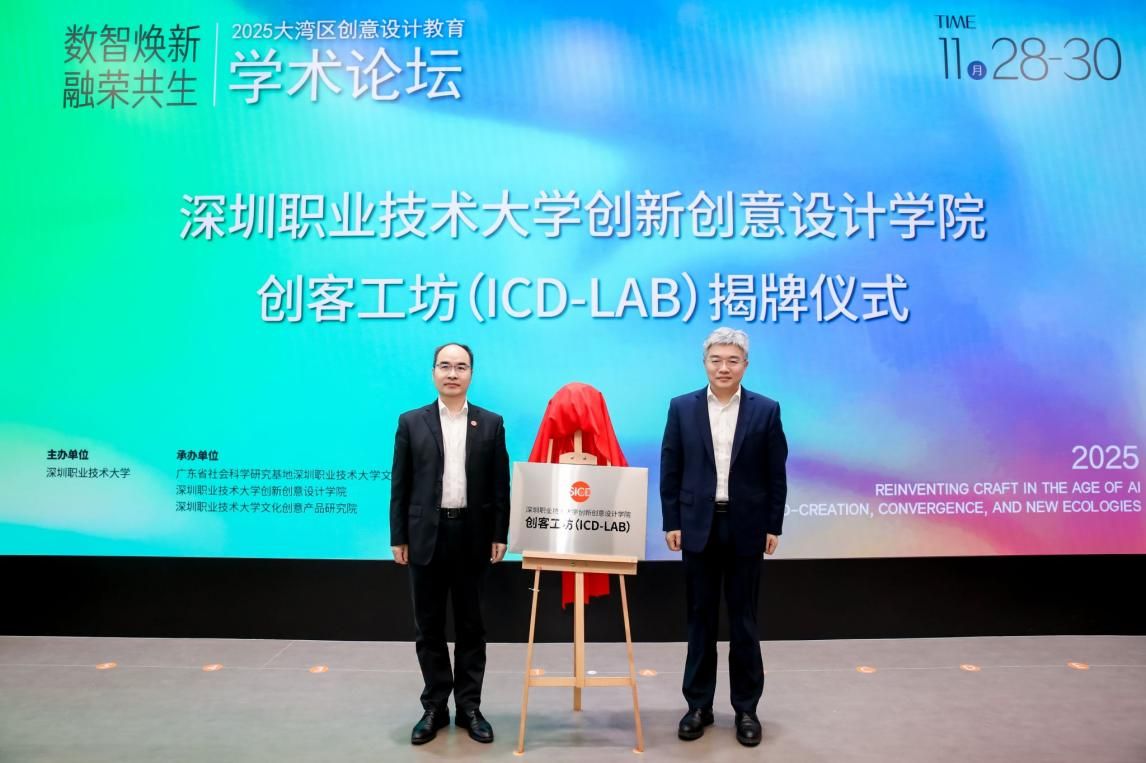
The ICD-LAB of the School of Innovation and Creative Design at SZPU was officially inaugurated.
On November 29, the “Digital Intelligence Empowering Renewal · Integration and Symbiosis—2025 Greater Bay Area Academic Forum on Creative Design Education” opened at Lecture Hall No. 1 of the Library, Xiangmi Campus, Shenzhen Polytechnic University (SZPU). The forum was hosted by SZPU and organized by the Cultural and Creative Application Research Center of SZPU (a Guangdong Provincial Social Sciences Research Base), the School of Innovation and Creative Design, and the Institute of Cultural and Creative Product Research.
Attending the opening ceremony were Ye Xiaobin, Deputy Secretary of the Party Committee, Vice President, and General Manager of Shenzhen Media Group, and Xu Jianling, Deputy Secretary of the CPC Committee and President of SZPU. Nearly 200 participants—including experts and scholars from China and abroad, representatives from universities across the Guangdong–Hong Kong–Macao Greater Bay Area, industry associations, enterprises, as well as faculty and student representatives in design disciplines—took part in the event. The opening ceremony was chaired by Shao Yu, Distinguished Dean of the School of Innovation and Creative Design and Dean of the Institute of Cultural and Creative Product Research.
In his opening remarks, Xu Jianling noted that as China’s first “City of Design,” Shenzhen benefits from strong policy support and industrial clustering, making it a national hub for creative design. In the face of opportunities and challenges brought by AI and digital technologies, the forum serves as a cross-disciplinary dialogue platform, focusing on topics such as the innovative inheritance of traditional craftsmanship, and supporting the deep integration of industry and education as well as the cultivation of new quality productive forces.Ye Xiaobin emphasized that Shenzhen Media Group, as a key participant and builder of the City of Design brand, looks forward to further strengthening cooperation with SZPU in the digital era. He expressed the hope that design achievements can move from academic settings into real-world markets, allowing industry–education integration to become a vital link connecting the education chain, talent chain, industrial chain, and innovation chain.Following the remarks, the School of Innovation and Creative Design officially established its Industry–Academia–Research–Application Strategic Advisory Committee, with a concurrent appointment ceremony for committee members. This initiative lays a solid foundation for advancing collaboration between universities, local governments, and enterprises, and for strengthening the integration of design education with industry practice.Subsequently, Xu Jianling and Ye Xiaobin jointly unveiled theICD-LAB of the School of Innovation and Creative Design at SZPU, marking a key step forward in building an integrated platform encompassing creative practice, achievement transformation, and talent cultivation.
During the keynote session, renowned experts and scholars from institutions including Tsinghua University, Hunan University, University of Macau, and Istituto Marangoni Shenzhen Campus shared insights on topics such as intelligent design, human factors and cultural big data, contemporary transformation of traditional arts, technological innovation in the fashion industry, and the application of AI in medical and industrial design. These presentations provided multidimensional perspectives on the future directions of design education.The teachers’ forum focused on themes such as digital transformation in education, development of the New Liberal Arts, contemporary relevance of intangible cultural heritage, AIGC-driven creativity, and immersive design research, with in-depth discussions on practical pathways for value guidance, competency development, and curriculum system restructuring in design education.
On November 30, the forum continued with in-depth exchanges through two themed workshops: “Creative Design Education Workshop: Curriculum Reform and Talent Cultivation Practice in Introduction to Design (Joint Teaching and Research Activities)” and “Creative Design Education Workshop: Teaching Practice in Fashion Product Design in the Digital Intelligence Era.” In parallel, the Meeting of the Glass Art Committee of the China Arts and Crafts Society was also held, providing a platform for targeted dialogue and collaborative innovation.
Driven by digital intelligence and guided by the principle of integration and symbiosis, the forum fostered deeper communication and consensus-building, offering new perspectives and methodologies for teaching reform and industry–education collaboration in creative design education. The experiences and outcomes generated will serve as valuable references for improving talent cultivation systems and expanding industry cooperation, while also laying a solid foundation for sustained exchange and collaborative development of design education across the Greater Bay Area.
(Reported by Yu Yan, School of Innovation and Creative Design)
 School Motto:

 Search