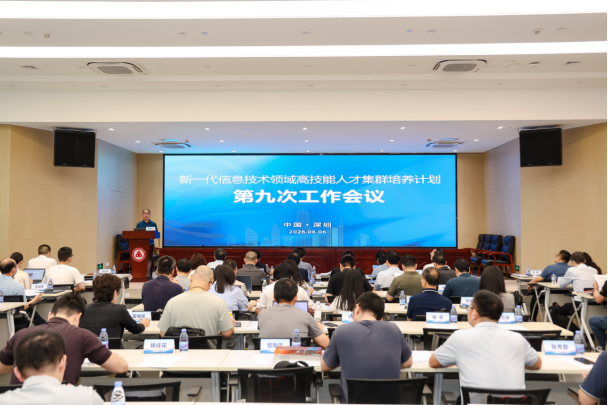
The 9th Working Meeting of the High-Skilled Talent Cluster Development Initiative in the New-Generation Information Technology Field was held at SZPU.
On June 6, the 9th Working Meeting of the High-Skilled Talent Cluster Development Initiative in the New-Generation Information Technology Field was held at SZPU. Leaders, experts, and scholars from the Center for Vocational Education Development, Ministry of Education, the China National Academy of Educational Sciences, Higher Education Press, and 13 vocational colleges nationwide gathered at theXiliLake Campus to conduct in-depth discussions on advancing the pilot implementation of the initiative in the new-generation information technology field and the open course “CangjieProgramming Technology and Application”.
Xu Jianling, Party Secretary of SZPU; Zhao Xiangjun, President of Nanjing Vocational College of Information Technology; YangXudong, Vice President of Wuhan Technical University; Zhu Min, Vice President of Changzhou University of Information Technology; JiZhaohua, Vice President of Beijing Information Technology College; Wang Yiwen, Deputy Director of the Teaching and Textbook Division of the Center for Vocational Education Development, Ministry of Education; and Han Qian from the Institute of Vocational, Technical and Continuing Education of the China National Academy of Educational Sciences attended the meeting. The meeting was chaired by Liang Zhaofeng, Party Committee Member and Vice President of SZPU.
On behalf of SZPU, XuJianlingwelcomed the attending leaders and experts and introduced the practical achievements of the initiative in academic programs, curricula, and textbooks. He noted that the initiative is a key component of the “New Double-High Reform Pilot Initiative” and has been incorporated into the three-year action plan for building an education powerhouse. Focusing on industry needs, the initiative promotes coordinated reform of five key teaching elements and drives the transformation and upgrading of talent development models. As primary institutions for cultivating high-skilled talent, vocational colleges’ continued efforts in cluster-based talent development are both a practical response to industrial transformation and an important measure for implementing the national strategy for high-quality development of vocational education. He expressed hope that all participating parties would use this meeting as an opportunity to strengthen collaboration and jointly build a new ecosystem for vocational education featuring high-quality institutional development and industry-education integration.
At the meeting, Wang Yiwen delivered a report titled “Deepening Reform of Key Elements in Vocational Education Teaching”. She reviewed the policy evolution related to reforms of key teaching elements, interpreted reform requirements from five dimensions — academic programs, curricula, textbooks, teachers, and practical training — and introduced the implementation outcomes of the “Three Group Leader” mechanism and digital textbooks such asCangjieProgramming based on pilot results of the initiative. She also outlined measures for the next stage of reform implementation. Han Qian systematically explained the strategic objectives, organizational mechanisms, and implementation pathways of the initiative. She interpreted the reform logic and strategies for cluster-based talent development, proposing the use of competency maps as a core framework, strengthened industry-school collaboration, and the transformation of practical achievements to promote innovation-driven development in vocational education. HaoYupeifrom Higher Education Press shared insights on approaches and key implementation points for developing smart courses.
During the morning special reporting session, He Miao, Dean of the School of Artificial Intelligence at Nanjing Vocational College of Information Technology, and Lai Min, Deputy Dean of the School of Communication Engineering at Sichuan Post and Telecommunication College, presented progress reports on the development of academic program standards and curriculum standards. XiaJiyuanand Qin Yudi from SZPU’s School of Electronic and Communication Engineering reported on the preparation progress of new programs in the field.
In the afternoon, the open course “CangjieProgramming Technology and Application” was held in Building B ofGewuGarden. HeJianbiao, Vice Dean of SZPU’s School of Undergraduate Education, presented the course design, practical training implementation, and other development achievements. Following the open course, participants held group discussions on topics including implementation of programming courses, joint development of practical training resources, and curriculum standard optimization. Representatives shared challenges and innovative approaches based on their respective institutional contexts.
The meeting reviewed the progress achieved under the initiative and made arrangements for future work, including joint development of academic program standards and curriculumstandards by schools and enterprises, online course development, and joint establishment of internship and practical training bases. The meeting provided clear direction for advancing further development in the field.
(Zeng Hongru, School of Electronic and Communication Engineering)
 School Motto:

 Search