On June 16, at the invitation of Lee Chi-kin, President of The Education University of Hong Kong, Chairholder of the UNESCO Chair in Regional Education Development and Lifelong Learning, and Director of the UNESCO-UNEVOC Centre (Hong Kong), Xu Jianling, Party Secretary of SZPU and Chairholder of the UNESCO Chair on Digitalization in TVET, attended the UNESCO-UNEVOC Seminar on Technical and Vocational Education and Training at The Education University of Hong Kong.
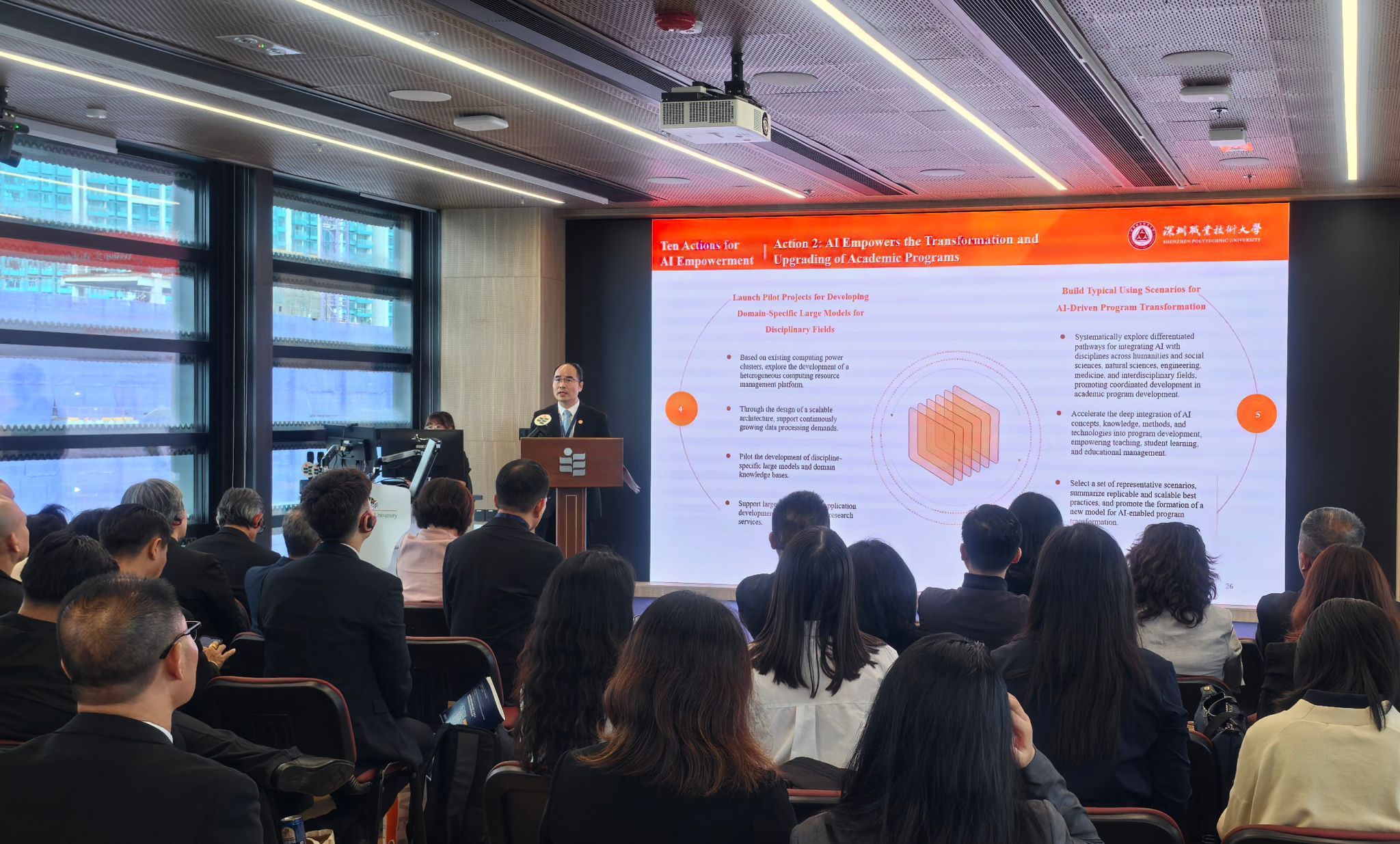
XuJianlingdelivered a keynote speech titled “Artificial Intelligence Reshaping Technical and Vocational Education: Integration Approaches and Innovative Practices at Shenzhen Polytechnic University”. The report reviewed the evolution of artificial intelligence, analyzed its profound impact on industrial innovation, skills frameworks, and talent standards, and examined the opportunities and challenges brought by AI-enabled vocational education in light of Shenzhen’s industrial strengths and vocational education positioning. XuJianlingproposed pathways for high-quality and sustainable development and shared SZPU’s ten major initiatives for AI-enabled vocational education. The report also introduced SZPU’s specific initiatives inAI-enabled vocational education, including AI-supported classroom teaching, application-oriented AI talent cultivation, development of domain-specific intelligent manufacturing models, establishment of specialized industry-oriented colleges with leading enterprises, and joint development of next-generation information technology courses with leading universities and enterprises.
The seminar, themed “Reshaping Technical and Vocational Education and Training: Toward the Future of Education”, aimed to provide a platform for dialogue and exchange, jointly exploring how vocational education systems can become more inclusive in a rapidly changing global environment and address global transformations with a forward-looking vision. Participants engaged in discussions on UNESCO’s priority areas, focusing on key topics including future skills, digital transformation, green competencies, lifelong learning pathways, and partnership development.BorheneChakroun, Director of the UNESCO Division for Policies and Lifelong Learning Systems, together with scholars, policymakers, and institutional representatives from UNEVOCCentresacross Asia, universities, international TVET institutions, and related organizations, gathered at the event to share professional insights and practical experiences, promote dialogue and mutual learning, strengthen collaboration, and jointly advance innovation and development in technical and vocational education and training in a technology-driven and knowledge-oriented era.
Through participation in this seminar, SZPU further strengthened communication and collaboration with UNESCO-related Chairs, regional TVET liaisoncentres, education authorities and universities from multiple countries. During the meeting, the delegation engaged in in-depth exchanges with representatives from the UNESCO Regional Office in Jakarta, the SEAMEO Regional Centre for Vocational and Technical Education and Training (SEAMEO VOCTECH),the Office of the Vocational Education Commission under Thailand’s Ministry of Education, the Korea Research Institute for Vocational Education and Training, Malaysian polytechnics and community colleges, as well as representatives from mainland Chinese universities.
Following the seminar, university leaders Xu Jianling and Cai Tie participated online from SZPU in a special session between The Education University of Hong Kong and representatives of mainland Chinese universities. Participants engaged in in-depth discussions on future cooperation in areas including joint talent development, collaborative research, and faculty training.
(Wang Bingfeng, Office of International Exchange and Cooperation, UNESCO TVET Liaison Centre)
 School Motto:

 Search