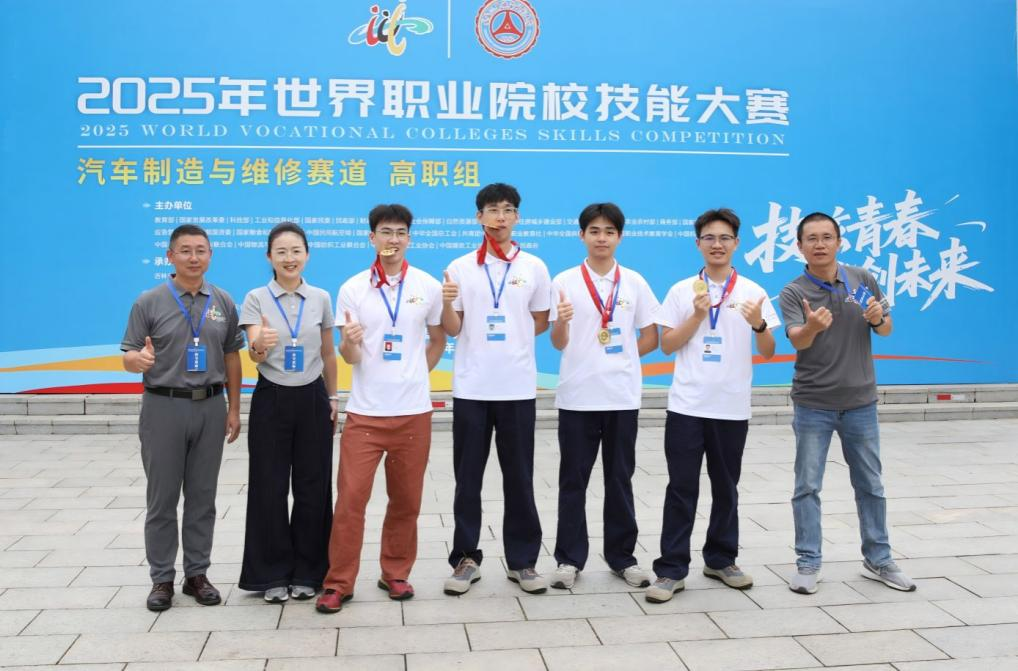
From August 24 to 31, the final of the “Automotive Manufacturing and Maintenance Track” (Higher Vocational Group, Intelligent Connected Vehicle Technology) of the 2025 World Vocational College Skills Competition was held at Changchun Technical University of Automobile. Our School of Automotive and Transportation Engineering’s team from the Intelligent Connected Vehicle Technology program won the gold medal with outstanding performance.
The competition was jointly organized by over 30 ministries and commissions including the Ministry of Education, the National Development and Reform Commission, and the Ministry of Science and Technology. It was hosted by the Education Department of Jilin Province and co-organized by the Changchun Municipal People’s Government and Changchun Polytechnic University. In the Higher Vocational Group of the “Automotive Manufacturing and Maintenance Track”, 104 teams from across the country competed, with only 10 teams winning gold medals.
Our team consisted of four students from the 2023 and 2024 cohorts of the Intelligent Connected Vehicle Technology program, focusing on sensor calibration technology in intelligent connected vehicles. The project covered six key stages: building a mobile calibration space, sensor testing and installation, intrinsic calibration of visual sensors, 360-degree surround-view calibration, extrinsic calibration, and integrated verification. During the competition, our team demonstrated not only excellent technical skills and professionalism, but also strong teamwork and highly innovative product ideas with significant application value in the field of intelligent connected vehicles, earning high recognition from the judges.
Behind this honor lies the strong technical competence and tireless dedication of our teachers and students. Closely aligned with real job requirements in sensor installation and calibration, the competition prompted the team’s instructors—teachers Zhao Jianfeng, Han Chengwei, and He Shanshan—to apply their expertise and develop core technologies such as mobile calibration spaces, calibration robots, electronic ground mats, and AI-based joint calibration algorithms, greatly improving calibration speed and accuracy. They also applied digital twin technology and AI visual analysis to quality inspection, ensuring standardized and controllable calibration processes with traceable quality.
(Zhao Jianfeng, School of Automotive and Transportation Engineering)
 School Motto:

 Search