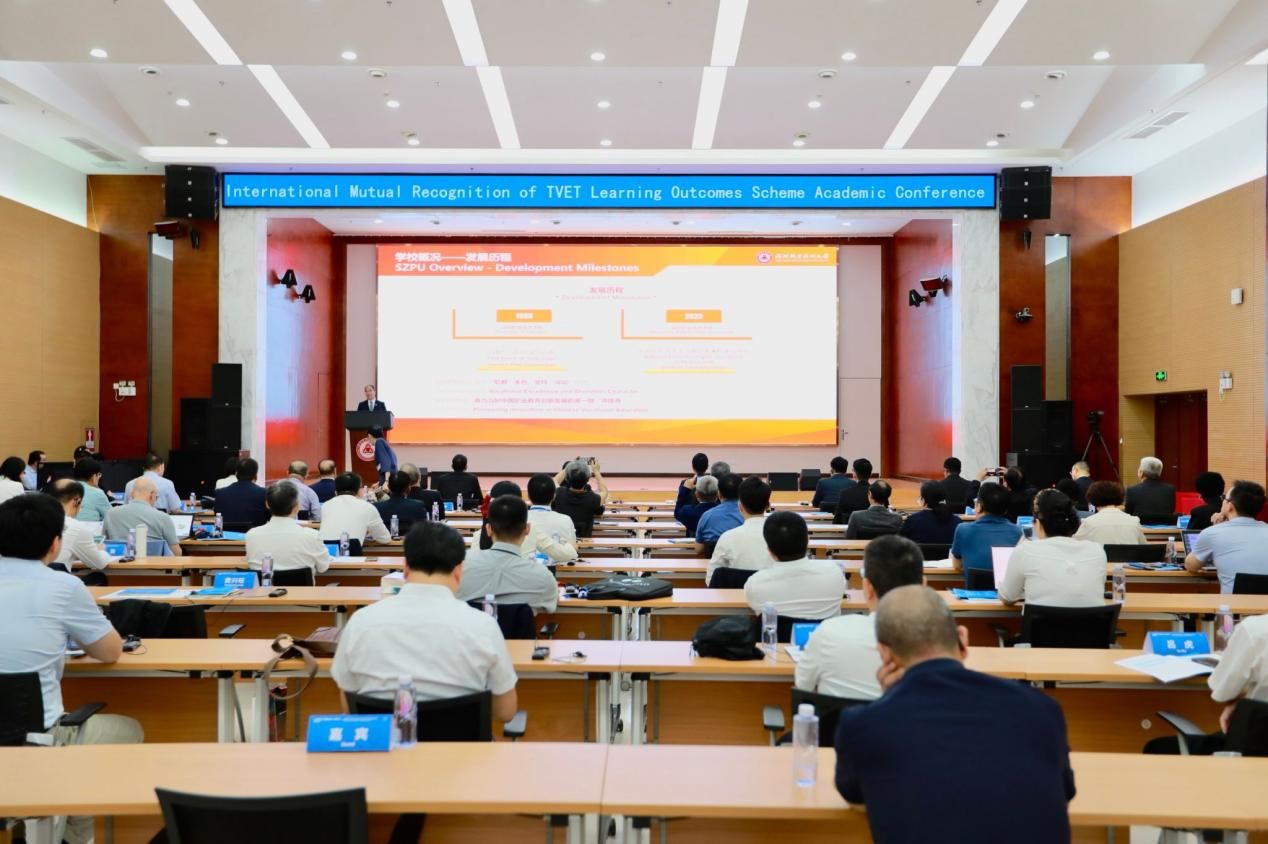
The conference was held in Conference Room 1, Tongde Building.
On October 12, an International Academic Conference on the Mutual Recognition of Learning Outcomes in Vocational Education, hosted by Shenzhen Polytechnic University (SZPU), was successfully held in Shenzhen. More than 60 participants—including officials from ministries of education, experts and scholars, university leaders, and representatives from leading enterprises—gathered from Laos, Thailand, Malaysia, Cambodia, Ghana, Zimbabwe, and other countries and regions. Centered on the theme of“Building an Open, Inclusive, and Collaborative International Framework for the Mutual Recognition of Learning Outcomes in Vocational Education,”the conference facilitated in-depth discussions on talent development and outlined a shared vision for global skills connectivity.
Distinguished attendees included Zhong Jiajun, Deputy Director of the Foreign Affairs Office of the Shenzhen Municipal People’s Government; Liu Zhibin, Director of the Division of Higher Education of the Shenzhen Municipal Education Bureau; Chaipat Lawsirirat, Director of Academic Affairs Administration, Department of Higher Education, Ministry of Education and Sports of Laos; Syvanh Phon Asa, Director of the Office of the Department of Higher Education, Ministry of Education and Sports of Laos; Xu Shunhong, Principal of the Vientiane China–Laos Friendship School; Khoo Yau Chong, President of the Malaysian Furniture Council; Chapa Lawsirirat, Dean of the Faculty of Sports Science, Chulalongkorn University, Thailand; Suong Savorn, Executive Officer of the University of Economics and Finance, Cambodia; Wu Junxian, Dean of the Faculty of Engineering and Technology, Universiti Tunku Abdul Rahman (Malaysia); Omaima Rassilia, representative of Northeastern State University (USA); Aiminjiang from the Tajik Metallurgical Institute; Duan Xiaofei, General Manager of CIIC International Education Technology (Beijing) Co., Ltd.; Leung Ting Hung, Chairman of Supro Global Ltd. (Hong Kong); Wang Zhifeng, President of Jiangsu College of Finance and Economics; Yan Zhiming, Vice President of Jiangsu Vocational College of Agriculture and Forestry; Jin Zhifang, Vice President of Jiangxi Environmental Engineering Vocational College; Professor Sun Shanxue, Director of the Shenzhen Agreement Expert Committee; and Xu Jianling, Deputy Secretary of the CPC Committee and President of SZPU.The conference was chaired by Liang Zhaofeng, Member of the CPC Committee of SZPU and Dean of the School of Mechanical and Electrical Engineering.
In his opening remarks, Zhong Jiajun emphasized that establishing an international system for the mutual recognition of learning outcomes in vocational education serves as a “golden key” to creating a global skills “passport.” He noted that this initiative represents Shenzhen’s active participation in global education governance, its concrete support for the Belt and Road Initiative, and its commitment to building a community with a shared future for mankind.Xu Jianling delivered a keynote address entitled“Advancing High-Quality Internationalization in Vocational Education.”He systematically outlined SZPU’s “one core with six dimensions” internationalization strategy centered on digital transformation, and highlighted the university’s efforts to promote the development and application of the “Shenzhen Agreement,” contributing a distinctive “SZPU solution” to international vocational education cooperation.
Professor Sun Shanxue provided an in-depth interpretation of the International Mutual Recognition Framework for Learning Outcomes in Vocational Education (the“Shenzhen Agreement Framework”). By establishing tiered standards, building curriculum systems, refining credit transfer rules, and strengthening quality assurance mechanisms, the framework offers a measurable, comparable, and mutually recognizable benchmark for vocational learning outcomes—presenting constructive Chinese insights and solutions for advancing global skills development and mobility. Representatives from animation production and new energy vehicle after-sales services shared practical application cases of the framework in specific occupational fields.
Representatives from international institutions—including the Ministry of Education and Sports of Laos, Chulalongkorn University in Thailand, the Malaysian Furniture Council, and the University of Economics and Finance in Cambodia—as well as leaders from domestic vocational institutions such as Jiangsu College of Finance and Economics and Jiangsu Vocational College of Agriculture and Forestry, shared their experiences and perspectives on international cooperation and mutual recognition of learning outcomes. They expressed strong recognition of, and expectations for collaboration under, the Shenzhen Agreement Framework.Enterprise representatives from CIIC, Huawei, Inovance Technology, and Sangfor Technologies discussed industry demand for internationally competent skilled professionals, underscoring the critical role of mutual recognition of vocational learning outcomes in ensuring talent quality and enabling precise industry–education alignment. Participants widely agreed that building an international system for mutual recognition of vocational learning outcomes is a pioneering and highly valuable endeavor that requires collective wisdom and coordinated efforts.
It is reported that the International Mutual Recognition Framework for Learning Outcomes in Vocational Education was initiated by SZPU in collaboration with theShenzhen Agreement Alliance of High-Level Chinese Vocational Institutions. As the world’s first systematic framework of its kind, the initiative has already engaged 40 institutions and more than 50 enterprises, marking a significant step forward for China in promoting global alignment of vocational education standards and mutual recognition of learning outcomes.
During the conference, SZPU, Jiangsu Vocational College of Agriculture and Forestry, and the Vientiane China–Laos Friendship School jointly signed a Memorandum of Cooperation on the International Mutual Recognition of Learning Outcomes in Vocational Education, signaling substantive progress in advancing international mutual recognition.
(Reported by Zhang Bin, Quality Assurance Center)
 School Motto:

 Search